


For many customers, the first interaction with a business no longer happens at a shop, office or over the phone. It happens online.
Someone hears about your business, sees your name on social media, receives a recommendation from a friend or discovers you through a search. One of the next things they may do is look for your website.
What they find can influence what happens next.
A professional website gives a small business a place to explain what it does, present its services, answer common questions and make it easier for potential customers to get in touch. More importantly, it gives the business an online presence that it can control.
In 2026, having a website is not simply about “being online.” It is about creating a reliable digital foundation for your business.
A Website Gives Your Business a Digital Home
Social media platforms, business directories and marketplace listings can all be useful. However, they are platforms operated by other companies. Their algorithms, features, policies and reach can change.
Your website is different. It provides a central destination where customers can find important information about your business, including:
- What your business does
- Products or services you offer
- Areas or customers you serve
- Contact information
- Business hours
- Frequently asked questions
- Portfolio, projects or examples of your work
- Articles and useful resources
- Enquiry or contact options
Instead of spreading important information across several platforms, your website can bring it together in one organised place.
1. A Professional Website Helps Build Trust
Imagine discovering two businesses offering similar services. One has a professional website with clear information, an About page, service details, contact information and consistent branding. The other has only a phone number and a few social media posts. Which one would you feel more comfortable contacting?
A website alone does not prove that a business is trustworthy. However, a professionally presented website can help visitors understand who you are, what you offer and how they can contact you.
Important trust-building elements can include:
- Clear business information
- Professional design
- Consistent branding
- Genuine contact details
- About the business information
- Service descriptions
- Secure HTTPS connection
- Privacy and other relevant policy pages
- Useful and regularly maintained content
For a small business, these details can make an important difference to the first impression.
2. Customers Can Find Information About You 24/7
Your office may close in the evening, but your website does not. A potential customer may search for your services early in the morning, during a lunch break or late at night. A well-structured website allows people to learn about your business whenever it is convenient for them.
They can check your services, read about your business, find your location, view frequently asked questions or send an enquiry without waiting for business hours. This does not replace personal customer service. It makes basic business information available before the conversation even begins.
3. Your Website Supports Search Visibility
One of the biggest advantages of having a website is the opportunity to appear in relevant search results. Suppose someone searches for a service that your business provides. Without a website, there are fewer pages from your business that search engines can discover, understand and potentially show for relevant searches.
A properly structured website can contain dedicated pages for your services, locations, useful information and other topics relevant to your customers.
For example, a business website may include:
Homepage → Service Pages → About → Contact → Blog → Helpful Guides
This gives search engines more context about the business and gives potential customers more useful information. However, simply launching a website does not guarantee rankings.
Search visibility depends on many factors, including website quality, technical accessibility, content relevance, competition, authority and how well the site satisfies users’ needs. A website creates the foundation on which a longer-term SEO strategy can be built.
4. A Website Makes Your Services Easier to Understand
A social media post has limited space and is usually designed for quick consumption. A website gives you room to explain your services properly. Instead of telling customers only:
“We provide website development.”
you can create a complete service page explaining the types of websites you build, your approach, important features, frequently asked questions and how someone can enquire. This is particularly valuable for service businesses where customers often need more information before making contact.
Clear service pages can also reduce repetitive questions because visitors can understand the basics before speaking with you.
5. Your Website and Social Media Should Work Together
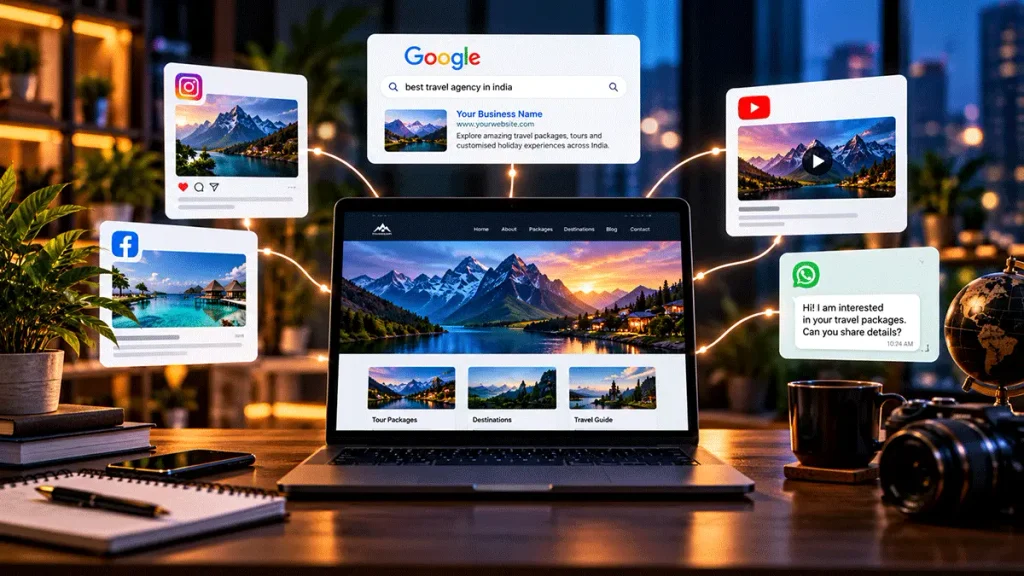
A business does not have to choose between a website and social media. They perform different roles. Social media can help you reach people, publish updates, build awareness and engage with an audience. Your website can provide the deeper information people may need when they become interested in your business.
For example:
Social Media Post → Website → Service Information → Enquiry
Similarly:
Google Search → Blog Article → Service Page → Contact
Your website therefore becomes a central part of a wider digital presence rather than an isolated marketing tool.
6. A Website Gives You More Control Over Your Brand
Your Facebook, Instagram or other social profile must operate within that platform’s layout and features. Your website provides much greater control over how your business is presented.
You can decide how to use:
- Your logo
- Brand colours
- Typography
- Photography
- Messaging
- Page structure
- Service presentation
- Calls to action
Consistent presentation across your website and other digital channels can make your business easier to recognise. For a growing small business, this becomes increasingly important as more people encounter the brand across different platforms.
7. A Website Can Turn Interest Into Enquiries
A good business website should not simply look attractive. It should help visitors take the next logical step.
Depending on the business, this might mean:
- Calling the business
- Sending an enquiry
- Starting a WhatsApp conversation
- Requesting a quotation
- Visiting the business location
- Booking an appointment
- Browsing products
- Reading another useful page
This is why website structure matters. Important actions should be easy to find without overwhelming visitors with buttons, pop-ups and competing messages. Good website design combines appearance with usability.
8. Mobile-Friendly Design Is Essential
Many potential customers will visit your website from a smartphone. A website that looks good on a desktop but is difficult to use on a smaller screen can create unnecessary friction. A modern business website should therefore adapt properly across different screen sizes.
That includes making sure:
- Text remains readable
- Navigation is easy to use
- Images resize correctly
- Buttons are easy to tap
- Forms work properly
- Important information is easy to find
- Pages remain practical on slower or smaller devices
Responsive design is no longer an optional extra for a professional business website.
9. Website Speed and User Experience Matter
People generally do not want to wait unnecessarily for a business website to load.Large images, unnecessary scripts, poorly configured plugins and inefficient design choices can make a website feel slow. Performance should therefore be considered during website development rather than treated only as an afterthought. At the same time, speed is only one part of user experience. A useful website should also have logical navigation, readable content, clear page layouts and straightforward ways for visitors to find what they need.
The objective is simple: reduce unnecessary friction between the visitor and the information they came to find.
10. A Website Can Grow With Your Business
A small business may initially need only a few pages. For example:
Home → About → Services → Contact
As the business develops, the website can expand. You may later add:
- Individual service pages
- Blog articles
- New locations
- Case studies
- Portfolio pages
- Frequently asked questions
- Product information
- Appointment or enquiry functionality
- Customer resources
Building a good foundation from the beginning makes future expansion easier.
11. Your Website Can Provide Useful Business Insights
A website can also help you understand how people interact with your online presence. With properly configured analytics tools, businesses can examine information such as:
- Which pages receive visits
- How visitors arrive at the website
- Which content attracts interest
- What devices visitors use
- Which pages people visit during their journey
- Whether important website actions are being completed
These insights can support better decisions about content, marketing and website improvements. Analytics should, of course, be implemented with appropriate privacy and consent practices where required.
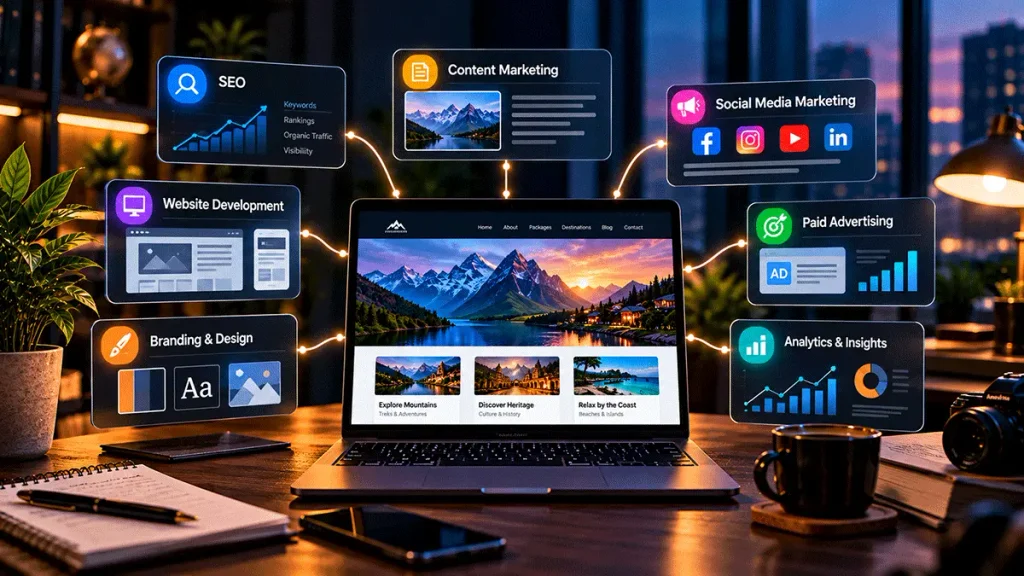
12. A Professional Website Can Support Other Digital Marketing Activities
Website development should not be considered separately from everything else a business does online.
A strong website can support:
SEO by providing useful, organised and technically accessible content.
Social media marketing by giving campaigns somewhere useful to send interested visitors.
Content marketing by providing a permanent home for articles, guides and resources.
Paid advertising by providing relevant landing pages for campaigns.
Local marketing by presenting consistent business and contact information.
Branding by maintaining a recognisable visual identity and message.
These activities can work together as parts of the same digital presence.
What Should a Small Business Website Include in 2026?
The exact requirements depend on the business, but a professional small-business website will commonly need:
- A clear homepage
- About the business information
- Dedicated service or product information
- Contact details
- Clear navigation
- Mobile-responsive design
- Appropriate calls to action
- Secure HTTPS
- Fast and optimised pages
- Relevant legal/privacy information
- Search-friendly page structure
- Useful original content
- Appropriate enquiry or contact options
Additional features should be added because the business genuinely needs them—not simply because they are fashionable.
Does Every Small Business Need a Large Website?
No.
A professional website does not have to be large or complicated.
A local service provider may need only a focused website with a few well-written pages. Another business may require dozens of service pages, articles, product listings or specialised functionality.
The better question is:
What information and functionality do your customers actually need?
A smaller website that answers this question well can be more useful than a large website filled with unnecessary pages.
Website Builder, WordPress or Custom Development?
There is no single correct platform for every business.
Website builders may work well for some simple requirements. WordPress can provide flexibility for many business websites and content-driven sites. Custom development may be appropriate when a project requires functionality or architecture that cannot be handled efficiently with an existing platform.
The decision should be based on requirements such as:
- Type of website
- Required functionality
- Content management needs
- Budget
- Scalability
- Maintenance requirements
- Integration requirements
- Technical resources
The technology should serve the business requirement—not the other way around
How Much Should a Small Business Website Cost?
There is no universal price for a professional website. Cost depends on the scope of the project, number and complexity of pages, design requirements, functionality, content requirements, integrations, eCommerce features and level of custom development involved.
Instead of comparing websites only by price, businesses should understand exactly what is included. A very inexpensive website that cannot be maintained, expanded or used effectively may eventually cost more in time and redevelopment.
Final Thoughts
In 2026, a professional website is more than an online brochure. It can become the central digital home of a small business—a place where potential customers discover what you do, understand your services, find useful information and decide how to contact you. It can also support SEO, content marketing, social media, advertising, analytics and future digital growth.
Most importantly, a business website should be built around real business requirements and real customer needs.
You do not necessarily need the biggest website. You need a website that is professional, useful, easy to navigate and capable of growing with your business.
Looking to Build or Improve Your Business Website?
DigiDost provides professional website development for small businesses, startups, professionals and service-based businesses.
Whether you are planning your first website or considering a redesign of an existing one, the focus should be on creating a website that represents your business clearly and provides a better experience for your visitors.
Explore our Website Development Services to learn more about how DigiDost can help build a practical, professional and growth-ready online presence.